Thursday, October 6, 2016

Phoenix - Born out of Fire and Ice

Phoenix - Born out of Fire and Ice


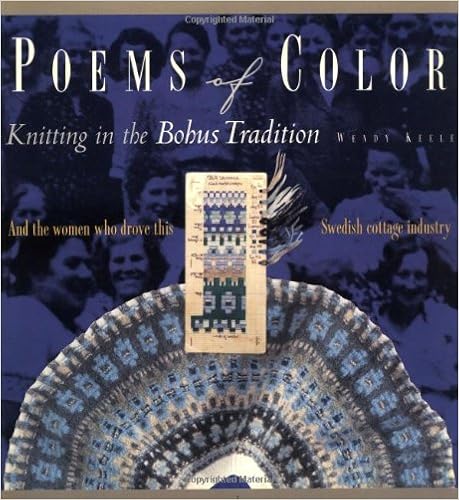
A sudden inspiration came over me this weekend. It ended up in a warm hat with  a Bohus inspired touch. The Bohuslän story is a very interesting one. I own this wonderful book about the Swedish community that created a knitting industry with local creative forces. Women came up with unique patterns for sweaters, jackets and accessories in this local Swedish cottage industry. 

Poems of Color is the name of the book and the author is Wendy Keeler.

It is an interesting read and a number of patterns to follow.


Last week I had some fun with the Bohus knitting idea and created The Phoenix Hat


It is a different technique than just stranded knitting. The mixture of knit and purl into the pattern creates interesting shades and shapes. It is really a challenge and satisfying work.

Thursday, January 7, 2016

Fine Flare Shawl - finished to order


Fine Flare Shawl


A 50 hour+ knitted shawl to keep you warm when challenging the cold weather
through late Fall, Winter and early Spring!
Pattern created by myself.

You can get this pattern by connecting through G+ and I'll arrange for how to pay for it ($5.00) and where to send your e-mail address so that I can send the PDF file.
(no sharing of e-mail addresses with third parties!)


Any fingering weight yarn in 100% wool works for me.

Made to order

 send me your color of choice and give me a week to order the yarn.
Here is the link: http://www.knitpicks.com/yarns/Palette_Yarn__D5420132.html
with 150 color choices.
Then I need 4 weeks to knit, soak and block the piece which leaves a finished product after a drying process.

Cost

 $ 120.00 for the work and $ 25.00 for the knitting yarn. 
You can bring your own yarn given that it does not contain any nylon, acrylic or polyester. 
(Sorry about that! I am hypo-allergic)

Deposit: I will need a minimum deposit of $50.00 before starting the process. 
It is easy and free: via www.paypal.me/WiktoriaW

Local Pickup or arranged place for delivery is fine. 
Mailing to your home-address is also fine.


Sunday, February 22, 2015

Touching Base with Fair Isle Part One

This question—what, exactly, is Fair Isle and how does it differ from other forms of stranded knitting?—is a bit hard to find the answer. As you might have noted, the words “Fair Isle” are now often used to define any stranded knitting designs. 

Janine Bajus wrote a short article on this subject for Interweave a few years ago (in their e-Mag Colorants). The appropriate paragraphs are pasted there:

The term “Fair Isle” is often used to describe any stranded color pattern, but Fair Isle knitting is unique. What separates Fair Isle from other types of stranded color knitting? 

Like other knitting traditions, Fair Isle knitting relies upon a profusion of patterns, some original and some borrowed from other cultures, but Fair Isle designs have a unique way of arranging colors that is instantly recognizable. This distinctive color use relies on value sequencing and mirroring within a motif to produce a luminous, three-dimensional effect. Sounds pretty complex, doesn’t it? 
Let’s break this down into four basic  elements:
#1 Value Contrast
“Value” means how dark or light a color appears. In color pattern knitting the pattern has to have enough value contrast from the background to show up. It doesn’t matter if the two colors are very different—if the value contrast isn’t there, the pattern won’t show up! 
#2 Value Gradients 
In a gradient (sometimes called a sequence), colors are arranged so that they move from light to dark (or vice verse). The use of gradients is key to the special effects of Fair Isle knitting. A Fair Isle design may move from one color family to another as long as the value sequence is preserved. 
#3 Mirroring
Fair Isle designs are generally symmetrical—that is, the pattern moves in to a center row and then reverses out of it. In other words, the pattern mirrors itself from a center turn point. Colors are used the same way: they follow a gradient in to the center row of the motif, then reverse symmetrically. 
#4 Color Families
Putting It Together
Value sequencing and mirroring combine to produce the characteristic luminous effect of Fair Isle knitting, which is emphasized by the use of a “pop” color at the very center of the motif. Although this center color is often bright, sometimes it is as subtle as a lighter or darker shade of the color that lies on each side of it. In Figure 3, the background and foreground colors both lighten in value toward the center, and the lightest value creates an accent in the center.

Fair Isle Colors

Fair Isle is home to Shetland sheep, which come in a very wide range of colors—there are at least 13 distinct colors and numberless blends. The earliest Fair Isle garments, dating from the 1850s, took advantage of these natural shades plus a limited number of naturally dyed colors such as: blues from indigo, reds from madder, and yellows from local plants and lichens. 
It is impossible to label any particular colors as “traditional.” At times certain colors have been more associated with Fair Isle knitting than others: muted shades in the ubiquitous Fair Isle yoke sweaters of the 1960s; natural sheep colors in the 1920s; bright, unexpected combinations in the early 1900s, when synthetically dyed yarn became widely available. 
Today’s knitters have several hundred colors to choose from, and designs incorporate more and more colors to produce beautiful watercolor-like effects. But beautiful and complex designs can also be created out of 4 or 5 colors. Simply changing where they are placed in the pattern changes how they appear. 


I’ve given this subject a lot of thought and I still stand with my assessment that value sequencing and mirroring are the core of traditional Fair Isle. There are some other characteristics—only two colors per round, no texture stitches, no long floats, etc—but these aren’t core design elements. 

As far as I can tell there is no such thing as “traditional” Fair Isle. Fair Isle knitting was/is, primarily, as source of economic earning power; as such it was under considerable pressure to change with fashions. Geometric patterns, fairly limited number of colors (compared to modern 14+ color garments), and repeated bands are all faster to knit than asymmetric, allover contiguous, large motif designs, so I would say that you would want to knit with such patterns if you want something that is generally traditional. 

The Art of Fair Isle Knitting by Ann Feitelson and Alice Starmore’s Book of Fair Isle Knitting would be the books to turn to. There are other, more specialized sources, but these have good sections on history of Fair Isle designs that would help to increase understanding and skill.
Sunday, February 8, 2015

Fair Isle or not, that is the question

A great confusion in the world 

about the use of the term 

Fair Isle

I am a Norwegian knitter (like my mother and grand mother) living in Pennsylvania for the time being.
Through the years I have done a lot of color-work knitting and followed mostly Norwegian patterns.

Internet has changed our access to the outer world and what is happening out there. We gain knowledge about new ideas and inspiration within a blink of an eye. The online knitting community Ravelry has come to mean a lot to me and now I see to 4 million other members.

The term "Fair Isle" is now floating around anywhere to-stranded knitting appears and has come to mean simply color-work. I have even seen typically Norwegian Sweaters called Fair Isle on Pinterest. From the search engine and various peoples blogs I had  hoped to find help to distinguish Fair Isle from other knitting styles, to really pin down the difference here and find a definition. The book with the "200 Fair Isle Motifs" has helped me a long way, but I wonder about  what is really the traditional Fair Isle knitting that separates it from the other color-work styles.


The Mystery


In some sweaters I have seen thees borders separated with a single row in contrast color. In some others I have seen the background color just continue "alone for 2 rows before the next border starts with 2 borders in a different background color and without a separating "line".
Other places I have found two colors meet and every other is knit in each color as a transition to the next pattern band/border.

Otherwise we are suddenly in England and knitting in large patterns and color-work that float all over and I think we have left the Fair Isle altogether. Sometimes I see that same style in Norwegian patterns, like with Solveig Hisdal were she studies old fabric from folk museums and transfer them into  large pattern work over the whole garment.

I really wanted to make my own true Fair Isle this time. In order to do that the distinct caracter of the Fair isle sweater must first be pin-pointed.


But the question remains, will that be possible?

Saturday, February 7, 2015

How the Fair Isle art of knitting and their knitters were abused.

Here is a strong article from one of the Fair Isle knitters:


Fair Isle Knitwear

From time immemorial its mid-Atlantic location and the barren, glacier scourged land has made scratching out a living in the Shetlands Islands difficult. Knitting has long been a staple to the economy of the Shetland Islands, the other being fishing. 

Everyone must understand there is only one legitimate place from whence Fair Isle knitwear comes and that is the Shetland Islands, Scotland. The knitwear is named from a tiny, rectangular shaped island which lies in the southern edge of the Shetland archipelago measuring but three miles long by one and a half wide. 

Reputedly influenced (doubtful) by Spanish Sailors ( not Moors since they were cast out of Spain in 1492) shipwrecked on said island in 1588, by the 1850s the knitters throughout the Shetland Islands were famous for their exquisitely crafted, brightly colored, banded knitwear of geometric patterns. Knitwear is still made by eight of the largely ex-patriot population (French-Venezuelan, Americans, Swedes, Norwegians, English) of Fair Isle numbering 68 and available through their co-operative, Fair Isle Crafts, and also by two more entrepreneurial ladies whose work commands as much as £1000 per garment. 


Thistle & Broom

Thistle & Broom does not offer Fair Isle knitwear from the Fair Isle Crafts cooperative. Nor do we offer hand-frame knitted garments of Fair Isle (if you are thinking about purchasing from another resource do confirm what it is that you are purchasing). Rather, Thistle & Broom offers authentic hand-knit Fair Isle created by septu and octogenarians Shetland ladies whose families have inhabited the Shetland Islands for hundreds of years and who learned from their aunts and grandmothers before them. That they offer authentic hand-knit Fair Isle at all came about because of a single story told over a generous tea provided by an artist I was visiting one mid-winter evening on the Shetland Isle of Unst. 

As a newlywed in the 1970s the young groom found himself standing in the Made in UK gallery of the veritable London luxury goods purveyor Harrods as he described 'sight-seeing'. He and his bride subsequently discovered a Fair Isle jumper bearing a price tag of £175.00 along with the label of their local knitting cooperative. Once back on Unst (current population about 700) he tracked down his knitting neighbor only to discover that she had been paid a mere £15.00 for nearly a month's worth of knitting and the cost of her yarns. I'm sorry no middle man in the world can justify that kind of profit over the cost of goods once it is made! I welled up with tears and righteous indignation caught tinder and has burned violently within me since. 

Nearly twenty years ago now, the government in trying to do the right thing, put in place a mandate that the knitters had to be paid minimum wage. So labour intensive are hand-knit Fair Isle garments that in turn the Shetland yarn mills that employed the knitters were very nearly bankrupt in the process (so much for government intervention) and the result was they ceased to be offered 'commercially' and forced the loss of all related income. Largely the way Shetlanders have gotten around this legislation is that when you walk into a shop in Shetland the garments you see, and may ultimately purchase, are offered on a kind of cooperative basis - the knitters are paid when their labours sell (whenever that might be). Prices are ridiculously cheap. The locals will say over and over that they feel people 'deserve' a bargain if people are coming all the way to Shetland - no, sorry, they don't! The knitters deserve a fair wage. The disparity between what the knitters are paid and what the perceived value to a Harrod's customers (as above) and the luxury goods marketplace have both done equal measure of creating an attitude of ambivalence within Shetland toward the continuation of its iconic legacy.
A Shetland woman (or man) applying more than sixty years of expertise and spending more than 110 hours hand-knitting a full size jumper and 12 hours on a pair of gloves still earns about £65 for the pullover and £11 for the gloves on the islands when their garment sells. Yet, walk into Harvey Nichols (Scotland's flagship luxury goods purveyor) and a machine-made, in Italy, merino wool Fair Isle inspired pullover (i.e. knock off) under Alexander McQueen's label sells for upwards of £240! What's equally important is that the purchase of Mr. McQueen's, or any other label, of 'Fair Isle style' fails to provide any economic benefit to Shetland. Both circumstances are equally abhorrent. As a result of the endemic poor compensation, the native population undervaluing their most globally recognised product and upscale clothing designers being inspired but not ethically compelled to source locally, instead of hundreds of legacy knitters of multiple generations continuing this iconic art form perhaps two hundred remain.
In totality this is exactly the reverse of how luxury goods houses create demand. Saville Row tailors and Bond Street cobblers, despite struggles, continue because their customers wait for perfection to be created for them and pay dearly for the privilege of ownership.
If authentic hand-knit Fair Isle was to have a chance to survive then waiting, as a connoisseur of an Hermès of Paris crocodile Kelly handbag waits, would need to be part of the business model. To bring cachet to Fair Isle knitwear demands that you are one of a finite number of people on a global basis each year who might own a bespoke effort of a Shetland hand-knitter and subsequently wait and pay accordingly. The bulk of that price, rightfully, belongs to the knitter who because of decades of knitting has honed her craft to an art form worthy of reverence. Of course with any luxury good there will be imitations. Unlike Harris Tweed which enjoys a certification process and an Act of Parliament to define it, Fair Isle Knitwear has become a generic term used by designer and High Street alike to sell ridiculously expensive to pathetically cheap knock-offs. The likes of Victoria Beckham and Rihanna are essentially wearing fakes... equal, in my humble opinion, to the 'designer' tat that is sold in boot sales, flea markets and on folding tables from street corners in urban centers all around the world. The 22,000 souls who call the Shetlands their home (including those residing on Fair Isle proper) do not enjoy the corporate legal power available to Ralph Lauren, Dolce and Gabbana and Alexander McQueen and the like to go after infringement and royalties. ANY hoodie, glove, scarf, mitten, polar fleece, cardigan, jacket, baby blanket or sweater you see at the local mall or in a catalog is 'fair isle inspired' and NOT authentic Fair Isle. I assure you brilliant ad campaigns to the contrary it's not bringing any economic value to Scotland on the whole and especially not the Shetland Islands or Fair Isle directly. Since 2003 Thistle & Broom has maintained (and voiced to any that might listen) that Fair Isle Knitwear needs to become like Harris Tweed and those Products of Designated Origin, PDO, such as Champagne, Parma Ham, and Pecorino Romano. In "our" perfect world royalties would be paid by designers and High Street retailers alike to a Shetland based trust for provide for quality assurance, certification, cataloging, educational programs, industry marketing and legal protection each time the term "Fair Isle Inspired" was used to market their products. The truth is, from an intellectual property perspective, it's a nearly impossible legal battle to fight and win. So brand awareness and education seems to be the greatest hope we (though my opinion is not widely solicited as I am not a Shetland native, I speak for all individuals involved in this cottage industry) have to stem the further decline of an irreplaceable piece of Scotland's rich cultural heritage. 
That is precisely why Thistle & Broom commenced its Fair Isle Knitting Project and why we're incredibly grateful when Scotland on Sunday, The Economist, The Independent, Daily Mail and The Times of London decide to offer a few columns to heighten awareness. 

The Fair Isle Knitting Project is designed to ensure the preservation of authentic hand-knitting of Fair Isle. To create financial incentive to subsequent generations of knitters 66% of the retail price is paid up front via EFT as orders are placed through our website. Their art features authentic Shetland long staple wool yarns processed within Shetland, two colours in each row forming amazingly intricate patterns of Peeries, XOX, Borders, Seeding, Waves and Peaks, Norwegian Stars and Allover. Passed from generation-to-generation and knit for hundreds of years of naturally occurring or paint box coloured Shetland yarns each extraordinary in workmanship, colour theory and hand craft which is entirely deserving of your appreciation and your patronage. 

End of article. 

In 2004 Fair Isle was entered under the Fair Trade tract.


Here is my first attempt to knit a Fair Isle Sweater. It is based on the front picture of Alice Starmore book which I order back in 2005 from overseas to Norway. To my great disappointment there was no pattern inside the book of this sweater, but I reconstructed it from the front picture and from some drawings inside. 

It is not knitted in Shetland wool, but "spelsau", a breed from the time of the Vikings. They have been able to save this breed and the yarn is still used in weaving and to some degree in knitting still, in Norway.

It is thicker than fingering, but just slightly.

Swatching a Fair Isle pattern

 Charted Rhona's Fair Isle Tunic is not ready to be knitted, not just yet


Stretched out in bed with a bad bug, what a way to start blogging. This can only improve.
I have been wrapped up in fair-isle pattern color creation. It is not easy to succeed and get the colors to sing.

From my horizontal position my view on knitting is slightly angled to a non-productive state.
It does not always have to be bad, not having some piecework or clothing growing on my needles.
There is a time to think things over too.

All those color worked patterns out there that I have knitted through the years. Maybe they have slowed down my own creativity and put me to sleep when it comes to make something on my own accord and with self confidence? (Hmm). Looking at my Fair Isle swatch I think that I am on to something.

As soon as my camera can start to up or is it download the pictures of the swatches I will post them here in memory of my struggles. 


Thsi is my first swatch ever on fair isle and I did it in Ocean City, just before the beginning of January 2015.

it is fun to play with yarn and colors and to see how things change when they are put into different relations in the pattern.

In time and with some more effort the Fair Isle might become more alive to me.